Six Stages, Three Owners: Why Your Funnel Breaks at the Handoff
Six funnel stages, three owners, four systems. The handoff between marketing, sales, and service isn't an org chart problem — it's a data model problem.
Most funnel diagrams show one clean path from stranger to customer. Your org chart tells a different story, and so does your CRM.
Here's the comparison worth sitting with. The six stages are identical on both sides. The only thing that changes is who owns them.
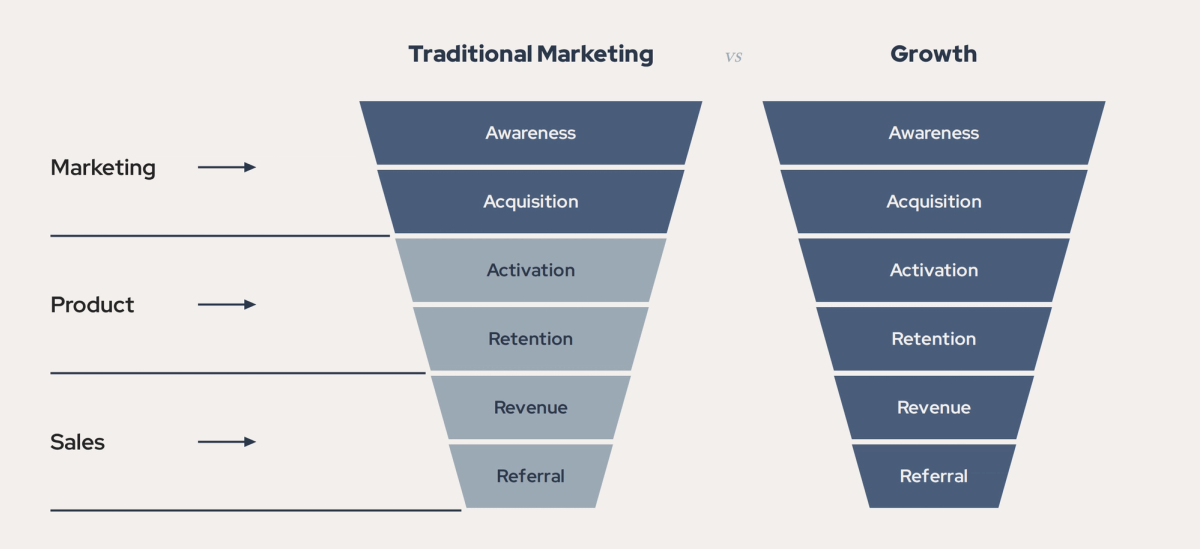
On the left, marketing owns awareness and acquisition, then hands the customer to product for activation and retention, then to sales for revenue and referral. The gray stages are the ones marketing never sees again. On the right, one team carries all six.
The gray blocks are system boundaries
That diagram usually gets read as an argument about marketing strategy. We'd argue it's really about architecture.
Everywhere ownership changes hands, a system changes too. Marketing works in one platform, product telemetry lands somewhere else, revenue lives in the CRM, support tickets sit in a fourth tool. The handoff isn't just a change of team. It's a change of database.
And systems don't hand off records. They recreate them. The lead your campaign generated becomes a new contact when sales picks it up, a new account when the deal closes, and a new case when something breaks. Same person, four identities, nothing connecting them.
What the split actually costs
- Attribution dies at the first boundary. You can prove which campaign sourced a lead. You usually can't prove which campaign sourced the renewal two years later.
- Nobody owns retention. It sits between product and sales on the org chart, which in practice means it sits nowhere.
- Every team reports a different number — not because anyone is wrong, but because each one is counting a different record for the same customer.
- The gray stages get almost no investment, even though that's where expansion revenue lives.
None of that is a people problem. Reorganizing the team won't fix it, because the fragmentation is in the data model, not the org chart.
What one funnel looks like in practice
Collapsing six stages under one owner is a strategy decision. Making it real is a systems decision, and it comes down to three things.
A single identity. Before anything else, the same person has to resolve to the same record at every stage. That's the real job of Data Cloud — identity resolution, not dashboards. Until it's done, everything downstream is an estimate.
Lifecycle stages as one model. Awareness through referral should be states on a shared object, not separate concepts living in separate clouds. When marketing, sales, and service all read the same lifecycle field, a handoff becomes a status change instead of a data migration.
Automation that crosses the boundary. The flows worth building are the ones that span the gray zone — the renewal risk that triggers a marketing touch, the product usage signal that opens a sales conversation. Those are impossible to build when each stage lives in its own system.
Where to start
Don't start with the funnel. Start with the record.
Map your customer's path through the systems you actually run, and mark every point where a new record gets created for someone who already exists. Those points are your gray blocks. In most orgs we look at there are three or four, and one of them is doing most of the damage.
Fix the identity layer first. Reporting, automation, and the lifecycle model all sit on top of it, and none of them will hold if the same customer is still four different people to four different teams.
Not sure where your handoffs are breaking? That's usually a one-conversation diagnosis. Get in touch and we'll walk your funnel against your architecture.
Ready to elevate your operations?
If your team is ready for the same kind of efficiency boost, let's talk about your path to a more integrated Salesforce setup.
Start the conversationRelated posts